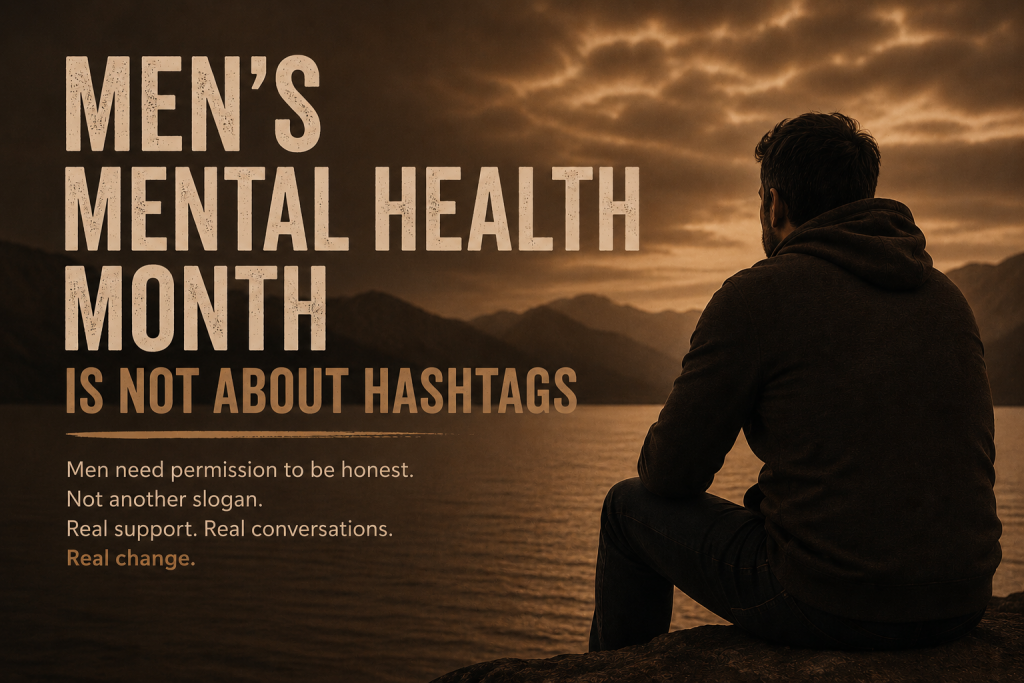
June is Men’s Mental Health Month, which means we are about to see the usual flood of hashtags, awareness posts, graphics in blue, and well-meaning slogans about men needing to talk more. And listen, I’m not against any of that. Awareness has its place. A hashtag can open a door. A post can make someone feel a little less alone. A campaign can remind people that men are struggling too.
But if we are not careful, awareness can become performance.
It can turn into one more thing we post about for a few weeks and then quietly forget when July rolls around. We share the graphic, we say the right thing, we nod along when someone says men need to open up, and then we go right back to a culture where a lot of men still feel like honesty has a cost.
That is the part that interests me more than the hashtag.
Because men do not need another slogan as much as we need permission. Permission to tell the truth without being mocked. Permission to say, “I’m not doing well,” without someone immediately trying to fix us, shame us, diagnose us, or tell us to toughen up. Permission to admit that anger might be sitting on top of grief. That silence might be hiding fear. That exhaustion might not just be about work.
I have spent enough years around recovery rooms, trauma work, men’s groups, and my own messy inner life to know that most men are not emotionless. That was never the problem. Most men are carrying plenty. The problem is that many of us learned early that carrying it quietly was safer.
We learned to make jokes. We learned to minimize. We learned to say “I’m fine” with a straight face while everything inside us was rattling around like loose change in a dryer. We learned to be useful, productive, strong, calm, funny, dependable, and occasionally impossible to reach.
Some of us became very good at appearing okay.
And that is where Men’s Mental Health Month can matter, if we let it be more than branding. It can be a reminder that men’s pain does not always announce itself in obvious ways. Sometimes it looks like irritability. Sometimes it looks like overworking. Sometimes it looks like withdrawing from people we love. Sometimes it looks like sarcasm, numbness, drinking, scrolling, disappearing into the garage, or saying “whatever” when we actually mean “I have no idea how to talk about this.”
For a lot of men, the first honest sentence is not dramatic. It is not a breakthrough scene in a movie with swelling music and perfect lighting. Sometimes it is much smaller than that.
“I’m tired.”
“I’m angry all the time.”
“I don’t know what’s wrong with me.”
“I’m lonely.”
“I need help.”
Those sentences may not look impressive on a poster, but they can change a life.
This month, I’m less interested in telling men to talk and more interested in asking what makes it hard for men to talk in the first place. Because simply shouting “open up” at men who have spent decades being rewarded for staying closed is not exactly a strategy. It is more like yelling swimming instructions at someone from the dock.
We need spaces where men can be honest without being turned into a project. We need friendships where checking in means more than “You good?” tossed across a room. We need families that can handle male vulnerability without treating it like a system error. We need men who are willing to model honesty in ordinary language, not just crisis language.
And we need to stop pretending that mental health only counts when it becomes an emergency.
That is one of the reasons I write here. Not because I have it all figured out. That would be a very short-lived fraud. I write because I know what it is like to live behind a face that tells the world one story while the inside is telling another. I know what it is like to confuse silence with strength. I know what it is like to think that asking for help means I have failed some invisible test of manhood.
It does not.
Asking for help is not weakness. Being honest is not weakness. Feeling deeply is not weakness. Grieving is not weakness. Needing rest is not weakness. Saying “I can’t keep doing this the same way” is not weakness.
Sometimes that is where healing starts.
So yes, let June be Men’s Mental Health Month. Let the hashtags roll. Let the awareness posts go up. Let the conversations happen. But let’s not stop at awareness. Awareness is the front porch. The real work is inside the house.
The real work is telling the truth.
The real work is listening when another man tells his.
The real work is noticing when “I’m fine” sounds a little too polished.
The real work is making room for men to be more than providers, performers, protectors, fixers, workers, punchlines, or problems.
Men are human beings. Complicated, tender, stubborn, funny, wounded, loving, avoidant, brave, frightened, and often doing the best they can with tools they were never properly given.
This month, maybe we give each other something better than a slogan.
Maybe we give each other permission to be honest.