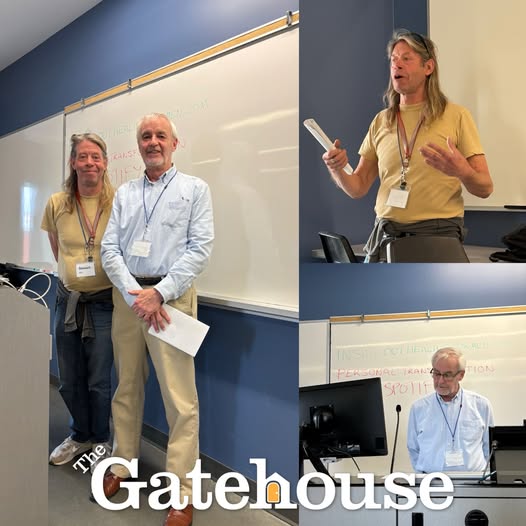
This past week I attended the Transforming Trauma Together Festival, a two-and-a-half-day gathering that brought together survivors of childhood sexual abuse, advocates, artists, educators, researchers, students, and community organizations to explore healing, resilience, and social change.
Well, truthfully, I didn’t just attend. I was part of the organizing committee.
That made the whole experience very different.
I brought my old event-world experience to the table, drawing on my years organizing the new media trade show and conference. It struck me more than once how funny life can be. Skills you think belong to some earlier chapter of your life suddenly become useful again in ways you never expected.
Our Thursday morning committee meetings became something I looked forward to. Yes, there was planning, logistics, programming, technical discussions, and the usual event coordination chaos. But there was also something deeper happening. Those meetings gave me space to show up in service, and that authentic part of me, the one that genuinely wants to help others, kept bubbling to the surface. There was something quietly magical about that.
And then, just like the old trade show days, after months of planning, suddenly the event was here.
The festival opened with a screening of Prey, the story of Rod McLeod’s legal battle against the Basilian Fathers over the abuse he suffered. Given my own history of abuse at the hands of a priest, you might assume this would have been a difficult or activating experience for me. Surprisingly, it wasn’t. It was moving, absolutely. Emotional, certainly. But not activating. That realization gave me pause. Healing has a strange way of revealing itself when you least expect it.
Tuesday began with a powerful opening session from Arthur Lockhart, founder of The Gatehouse, before the festival split into multiple tracks. My role, somewhat hilariously, was “technical guy.”
I had to laugh at that. At different points in my life I’ve been an entrepreneur, conference organizer, SEO consultant, and going way back to my days in Calgary, an AV technician. Or as I call it, a checkered career. Here I was 40 plus years later tapping into this long dormant skillset.
The opening night film was easy enough because the directors and participants were there in person for the Q&A. The other films, though, involved remote interviews over Zoom, and that became my responsibility. Now, in my mind, AV still means wheeling a giant TV strapped to a cart into a boardroom with a VCR underneath. Instead, I found myself standing behind a sleek podium full of mysterious buttons with appearing and disappearing screens, audio routing controls, and enough unfamiliar tech to make me question every life choice that had led me there.
Eventually, the first screening of the day, The Limits of Forgiveness, featuring Marlee Liss, played without any major disaster, and the Zoom discussion with participants went reasonably well. In my perfectionist mind, it felt clunky. To the audience, it felt seamless.
That was a good reminder.
So often the harshest critic in the room is the one inside our own head.
The second film, Braving Healing, brought some audio issues that only my discerning ears seemed to notice, while the audience remained fully engaged and deeply moved. I made plenty of mental notes about what I’d improve next time, because apparently perfectionism still gets a vote, even when nobody else notices the flaws.
Between screenings, I managed to attend a panel discussion about services available to men through Peel Region Health and hear firsthand from Bikers Against Child Abuse. I had read stories online before about their work, but hearing directly how they create safety and support for children was something else entirely. Some things hit differently when they are no longer abstract.
I also got to do something deeply meaningful. Alongside Stewart Thompson, host of the Personal Transformation Podcast, I gave a talk on digital storytelling.
I spoke about this blog, where it came from, why I started writing, and what reclaiming my voice has meant in my own healing. Stewart spoke about podcasting as another way for survivors and others on healing journeys to share their stories.
That conversation stayed with me.
So many survivors spend years, sometimes decades, without language for what happened to them. Finding your voice isn’t just creative expression. It can be part of recovery itself.
By the third day, the emotional depth of the festival had only deepened. There were survivor panels, expressive arts workshops, more films, more difficult conversations, and more opportunities for connection. I was responsible for running Magic & Monsters, the story of former child actors confronting abuse at the Minnesota Children’s Theatre Company.
And yes, I still hadn’t fully solved my Zoom issues. Again, I was probably the only one truly bothered by that.
Classic Mike.
What changed that day was that I had more room to breathe. More opportunities to connect with people I had seen at other events, meet new people, and have deeper conversations instead of constantly moving from one task to the next.
Community stopped being an abstract idea and became something I could feel.
I also had a moment of personal growth, though at the time it probably felt more like irritation.
Someone activated me. Old reactions surfaced. But unlike older versions of myself, I caught it quickly. I reflected, owned my part, and apologized almost immediately.
That felt significant.
Growth isn’t never being triggered. It isn’t becoming some endlessly calm version of yourself who floats through life untouched.
Sometimes growth is simply shortening the distance between reaction and accountability. AA Step 10 came to mind: when we were wrong promptly admitted it.
I also had some really thoughtful conversations with others in recovery about the distinction between recovery and healing. They overlap, certainly, but they are not the same thing. Sobriety removed the anesthetic. Healing is the work of facing what was underneath once the numbing stops.
By the closing session, where the first-of-its-kind book Listen was unveiled, I was completely drained.
Physically.
Mentally.
Emotionally.
But it was the good kind of exhausted. The kind that comes from pouring yourself into something meaningful.
And underneath that exhaustion was something even more important.
Connection.
Love.
Belonging.
The following day felt strangely familiar, reminding me of the day after one of my old trade shows. That same emotional crash. That same drained feeling once the adrenaline leaves your system and the body finally realizes what you’ve asked of it.
I made a half-hearted attempt at client work. I even landed an extended contract. But if I’m honest, I wasn’t really present. I was too depleted to focus fully.
And maybe that was okay.
Because over two and a half days, we helped create something remarkable. A space where survivors could be seen. A place for difficult conversations, honest storytelling, creativity, learning, and connection. A place where healing wasn’t expected to be neat or linear.
What stayed with me most was this.
So many of us learned to survive in isolation. To stay quiet. To handle things ourselves. To push through. To never need anyone.
But healing seems to ask something different.
Healing asks us to be seen.
To connect.
To let others witness the parts of us we’ve spent years trying to hide.
I arrived at the festival as an organizer, a speaker, and an overthinking tech guy wrestling with Zoom settings.
I left reminded that community itself can be medicine.
And that some healing doesn’t happen within us alone.
Sometimes it happens between us.