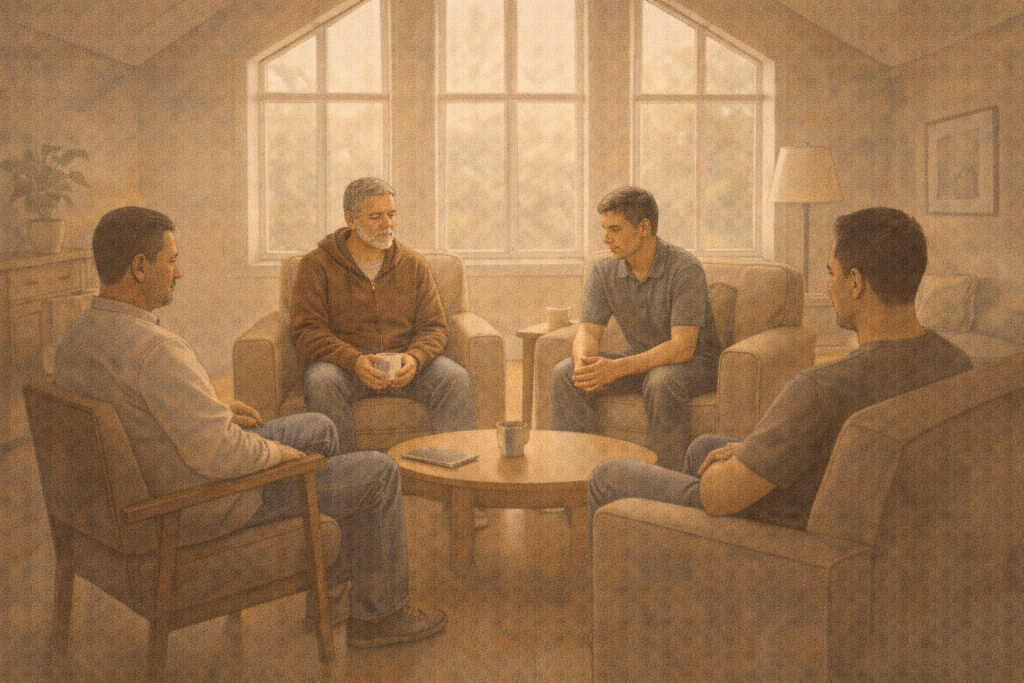
I had planned to write today about preparing to facilitate my next group at The Gatehouse.
The calendar said this was the week. Another men’s Phase 1 group at The Gatehouse. Another room. Another beginning. Another chance to sit with men as they start doing the brave, awkward, terrifying, necessary work of telling the truth about what happened, what it cost them, and what they have carried because of it.
Then the calendar did what calendars do best.
It became wrong.
The group has been postponed, so the week I had neatly framed in my head suddenly no longer looks like the week I thought I was writing into. The posts I had planned around returning to the room, showing up, holding space, and settling back into that responsibility are now sitting there looking at me like, “Well? What now?”
And honestly, that feels about right.
Because healing rarely follows the calendar either.
At first, I felt the familiar irritation of disruption. Nothing dramatic, an internal flinch that happens when something I had already made space for gets moved. I had started preparing myself for the room. Not just the practical part, although that matters too. Dates, reminders, materials, check-ins, the ordinary scaffolding that helps a group feel held before anyone says a word.
But the deeper preparation is quieter.
It is the inward checking. Am I grounded enough to listen? Am I clear enough to not make this about me? Am I humble enough to remember that no one’s story belongs to me, even when I am trusted to sit near it?
That trust is not a small thing.
When a man walks into a room like that, he is not just attending a group. He may be walking against years of silence. He may be walking against shame. He may be walking against every message that taught him to minimize, joke, tough it out, shut it down, or handle it alone. He may not even know yet what he is ready to say. He may only know that something in him is tired of carrying it by himself.
But what has emerged around the postponement is something I probably should not have been surprised by, and yet it still landed.
For some men, a room full of other men does not automatically feel safe.
That may sound strange when we are talking about a men’s group. The whole idea is to create a space where men can speak honestly with other men. A place where the usual performance can drop. A place where no one has to pretend they are fine. A place where the silence so many of us inherited can finally be interrupted.
But trauma does not respond to good intentions.
For some men, the idea of sitting in front of other men and speaking about what happened may feel like too much. Not because they are unwilling. Not because they are weak. Not because they do not need support. But because other men may be tied to what their bodies learned to fear.
Other men may represent judgment.
Disbelief.
Shame.
Ridicule.
Competition.
The old rules of masculinity.
The old command to toughen up, shut up, and never let anyone see where it hurts.
So maybe mixed company feels safer.
Maybe it feels less exposed. Less charged. Less like walking into the very place where silence was first enforced. Maybe having women in the room changes the emotional temperature enough for some men to breathe. Maybe it softens the edges. Maybe it interrupts the old hierarchy. Maybe it gives the nervous system permission to speak in a way that an all-male room does not yet allow.
That is not a failure of men’s work.
It is part of the truth men’s work has to be humble enough to face.
I believe deeply in men sitting with other men. I believe there is something powerful that happens when one man hears another man say the thing out loud. I believe there is healing in realizing you are not the only one who has carried silence like a second skeleton. I believe there is dignity in men learning to witness each other without trying to dominate, fix, compete, or disappear.
But belief is not the same as assumption.
And if I believe in safe spaces, then I have to believe men when they show us what safety does and does not feel like yet.
That is the harder humility.
It is easy to say, “Men need spaces to talk.” I believe that. I have lived that. I have been changed by that. But it is also true that some men may need a different doorway before they can enter that kind of space. Some may need mixed company first. Some may need one-on-one support first. Some may need to stand at the edge of the room for a long time before they are ready to sit in the circle.
The real work starts where men are.
Not where the calendar says they should be.
Not where my enthusiasm says they should be.
Not where the tidy idea of a men’s group says they should be.
Where they are.
And maybe that is what I am being asked to sit with before the room opens. Not just my own preparation to facilitate, but the deeper truth that the room itself has to be worthy of the men who may be afraid to enter it.
Safety is not declared.
It is practiced.
It is built slowly, through consistency, honesty, boundaries, patience, and respect. It is built when no one is rushed. It is built when no one is shamed for not being ready. It is built when we stop treating hesitation as resistance and start recognizing it as information.
Because for a survivor, hesitation may be wisdom.
The body may be saying, “I need to know more before I trust this.”
The heart may be saying, “I have been exposed before, and it did not go well.”
The nervous system may be saying, “I want help, but I do not yet know if this room is safe enough to let me be seen.”
That deserves respect.
So today, I am not writing the post I thought I was going to write. I am not writing from the edge of a room that opens this week. I am writing from the pause before a room opens later. A longer pause than expected. A pause that is asking better questions than my calendar did.
What makes a room safe enough for men to tell the truth?
What makes another man feel like a witness instead of a threat?
What has to be unlearned before honesty can happen?
And how do we honour the courage of men who are not ready for the room yet, but are still somewhere nearby, trying to find their way toward help?
That, too, is part of the work.
The calendar can move.
The room can wait.
The responsibility remains.