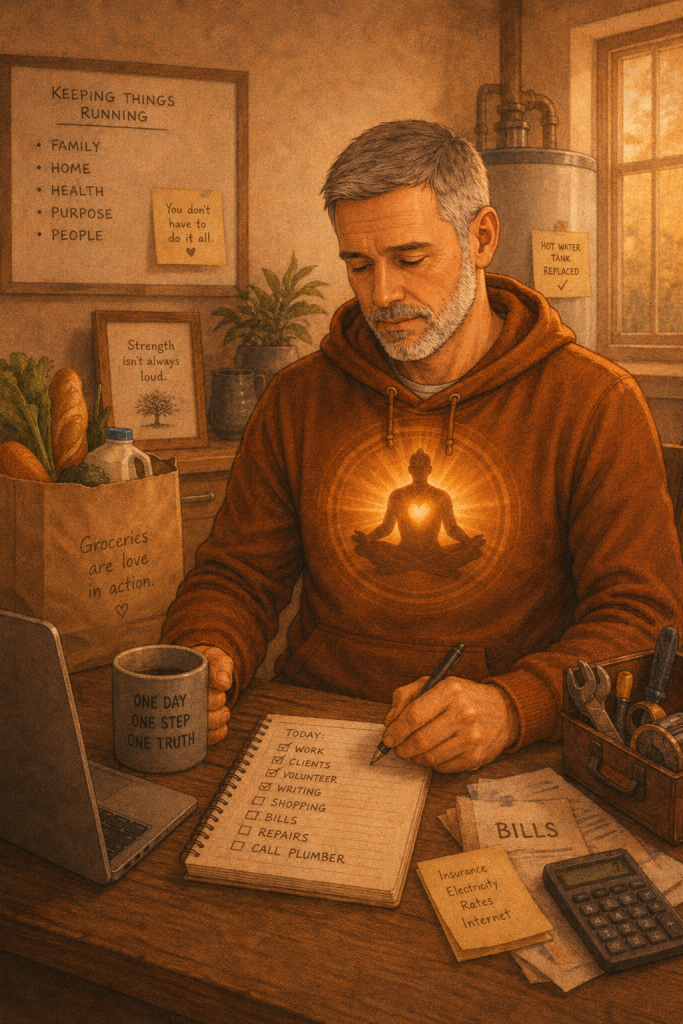
There is a kind of tired that does not come from one bad day.
It comes from being the person who remembers. The person who notices. The person who keeps the list in his head. The person who knows which bill is due, what needs fixing, what groceries are running low, what appointment is coming up, what emergency needs handling, and what cannot be allowed to fall through the cracks.
Nobody necessarily asks you to carry all of it. Sometimes you just do. Then one day you look around and realize not only have you become the operations manager of your own life, but, maybe everyone else’s too.
I have been thinking about this lately in my own life. On paper, I am self-employed and running a business. That alone is enough to keep the mental browser tabs open all day. There are clients, proposals, follow-ups, cash flow, deadlines, content, technical fixes, and the ongoing joy of trying to earn a living without losing your mind. Add in my extra curricular activities such as board work, the men’s groups, the blog, and whatever else I have decided is apparently a good idea to squeeze into a human week.
Then there is the home front. Menus. Groceries. Shopping. Making sure things get done. Making sure the bills get paid. Making sure the house does not slowly slide into chaos while everyone is busy being busy.
And then, of course, the hot water tank decides to join the conversation.
Because nothing says serenity like a household emergency arriving when your plate is already full.
I am not saying this to complain. That is always the disclaimer, isn’t it? “I’m not complaining.” We say it quickly, almost automatically, as if admitting something is heavy means we are being ungrateful. As if naming pressure means we are failing to appreciate what we have.
But not complaining is not the same as not struggling.
That is an important distinction.
A lot of men were trained, directly or indirectly, to carry things quietly. For some of us, that training started young.
For me, it started after my mother died. I was thirteen, almost fourteen, standing in the wreckage of a loss I barely had the tools to understand. At her funeral, a well-meaning aunt told me I would have to be the man of the family now. I know she meant it as encouragement. Maybe even as a compliment. But at that age, I did not hear comfort. I heard a job description.
So I took on the mantle.
Responsibility became part of my identity before I was old enough to know what that even meant. Being dependable became a kind of emotional armour. I learned to be useful. I learned to solve problems. I learned to anticipate needs. I learned to say, “I’ve got it,” even when what I really meant was, “I have no idea how much longer I can keep doing this alone.”
And when you learn that young, it does not simply disappear because you become an adult. It follows you. It becomes familiar. It can even feel noble. Until one day you realize the boy who was told to be the man of the family is still somewhere inside you, quietly trying to prove he can carry everything.
And because we could carry it, people assumed we were fine carrying it.
That is where things get dangerous.
Not dangerous in a dramatic way. More like erosion. Slow. Quiet. Almost invisible. The kind of wear that happens when a man keeps absorbing pressure without ever letting anyone see the cost. He becomes more irritable. More withdrawn. More tired. He starts losing patience over small things, not because the small thing matters that much, but because it lands on top of everything else he has not said out loud.
A dish in the sink is not just a dish in the sink.
A forgotten errand is not just a forgotten errand.
A busted water tank is not just a busted water tank.
Sometimes it is the one more thing that makes the whole structure groan.
And still, many of us will minimize it. We will make a joke. We will shrug. We will tell ourselves other people have it worse, which is true and also not the point. We will remind ourselves that this is just life. Bills, groceries, work, repairs, commitments, family, responsibility. We will keep moving because stopping feels risky.
The trouble is that many men confuse carrying everything alone with strength.
I know I have.
There is a part of me that still wants to be the guy who can handle it all. The calm one. The capable one. The guy who figures it out. The guy who does not need to ask for help because asking for help would mean the mask slipped.
Except that is not strength. Not really.
Strength is not pretending the load is light.
Strength is being honest about the weight before it crushes something important.
For men, emotional silence often gets dressed up as maturity. We call it being responsible. We call it not wanting to burden anyone. We call it keeping the peace. We call it handling our business. Sometimes there is truth in that. Not every feeling needs a committee meeting. Not every frustration needs to become a speech. There is value in steadiness.
But there is also a difference between steadiness and suppression.
Steadiness says, “This is hard, and I am still here.”
Suppression says, “This is hard, and nobody is allowed to know.”
Those are not the same thing.
I think a lot of men live in that second sentence without realizing it. We become fluent in silence. We carry pressure in our shoulders, our jaws, our stomachs, our sleep. We become short with people we love. We disappear into work, screens, errands, projects, or whatever keeps us moving just enough to avoid feeling how heavy things have become.
And when someone finally asks how we are doing, we give the classic answer.
“Fine.”
There it is again. The most dangerous little sentence in the English language.
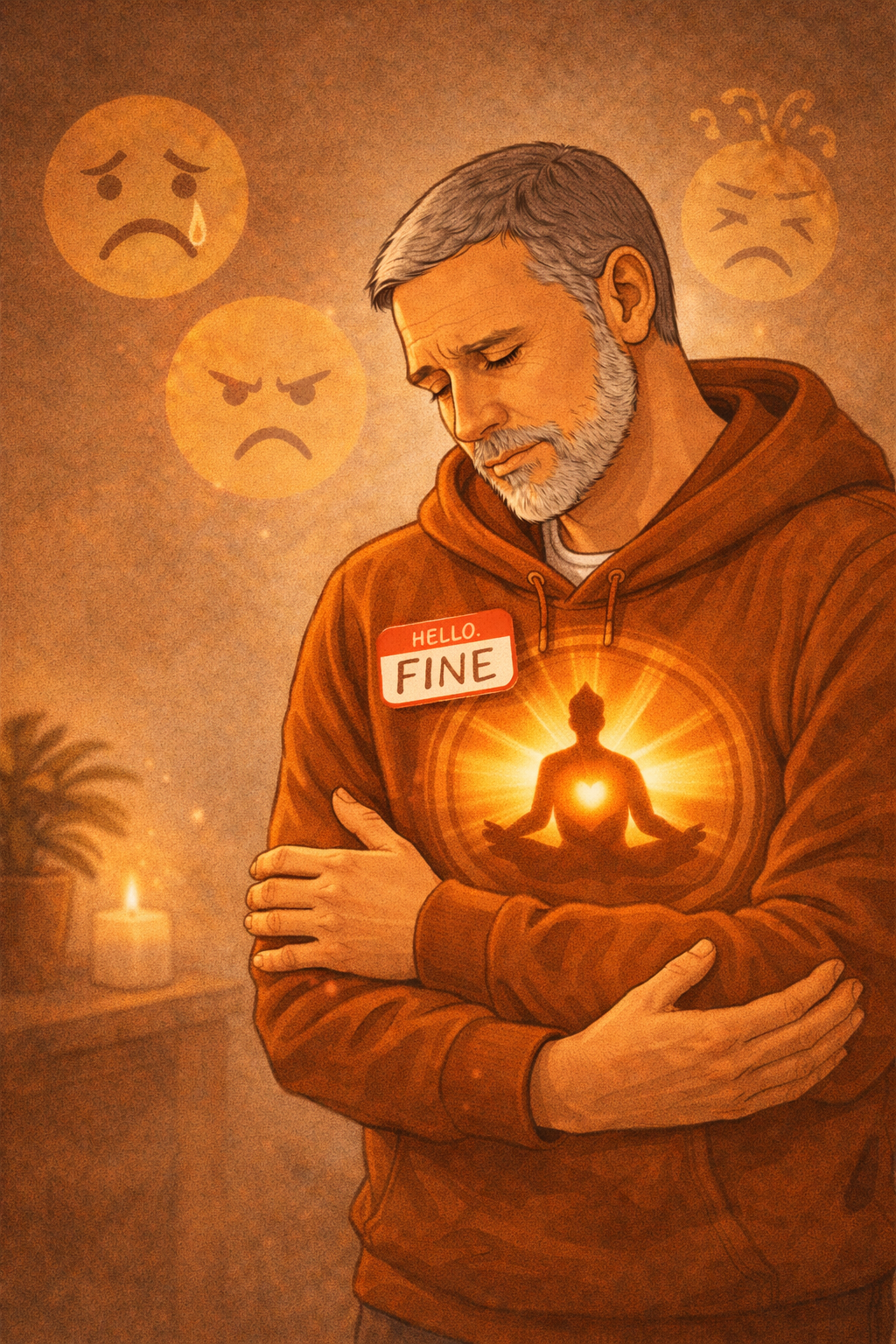
The problem with “fine” is that it can mean anything. It can mean I am actually okay. It can mean I am too tired to explain. It can mean I do not trust this conversation. It can mean I am afraid that if I start talking, I will not know how to stop. It can mean I have built an entire identity around being low-maintenance and I do not know how to be anything else.
I do not think men need to become emotionally theatrical. That is not what this is about. Most of us are not looking to turn every Tuesday afternoon into a group therapy intensive. Sometimes we just need a little more truth in the room.
“I’m carrying a lot right now.”
“I could use some help with this.”
“I’m tired and I don’t want to pretend I’m not.”
“I need to hand something off.”
“I don’t want advice. I just need to say this out loud.”
Those are not weak sentences. They are maintenance sentences. They keep resentment from building. They keep exhaustion from turning into anger. They keep silence from becoming isolation.
And maybe that is the real work for a lot of us. Not dropping every responsibility. Not walking away from the people and commitments that matter. Not declaring ourselves unavailable to life.
Just refusing to confuse quiet suffering with virtue.
Because the goal is not to become irresponsible. The goal is to become honest.
There will always be bills. There will always be groceries. There will always be something that breaks at the worst possible time because apparently hot water tanks do not respect calendars, cash flow, or emotional bandwidth. There will always be work to do and people to care about and tasks that need handling.
But maybe we do not have to carry all of it in silence.
Maybe strength looks like telling the truth sooner.
Maybe it looks like asking someone else to take the grocery run.
Maybe it looks like admitting that the mental load is real.
Maybe it looks like saying, “I can handle a lot, but I should not have to handle everything alone.”
That sentence alone could change a man’s life.
Not because it magically fixes the pressure.
Because it breaks the silence around it.