The Trigger
It didn’t take much.
An email saying “we’re not proceeding.” A shift in who’s in which meeting. On my screen, it was small. Normal even. The kind of thing that happens all the time to freelancers.
But my mind didn’t treat it like that. It treated it like a warning. Something bad is about to happen.
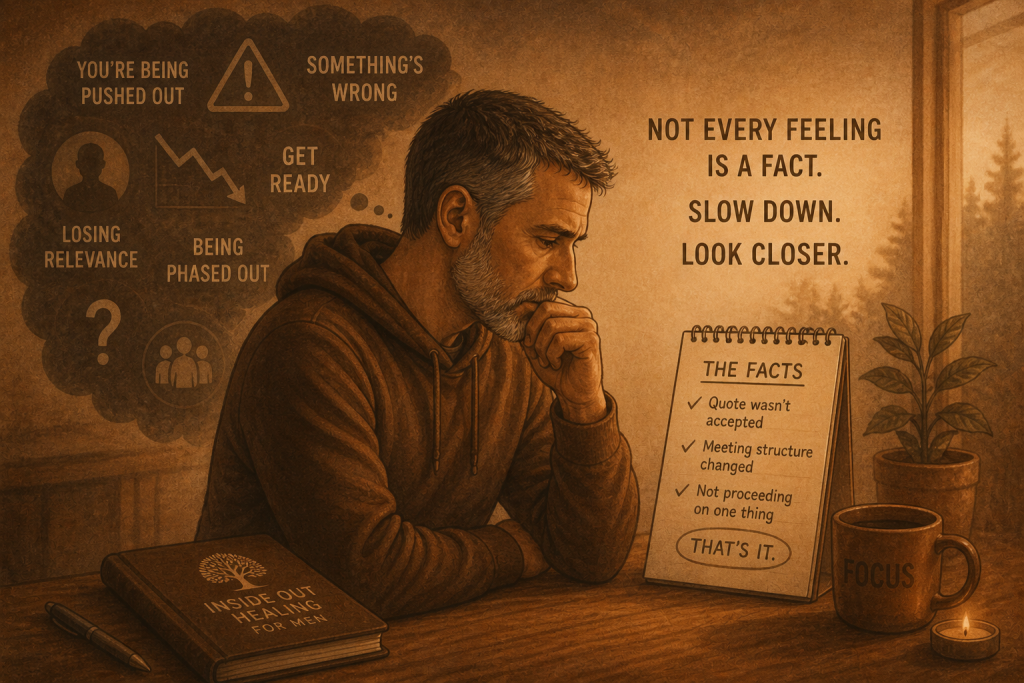
I didn’t sit down and decide to think that. It just showed up. Cunning. Baffling. Powerful. And just as quickly, everything started connecting. The rejected quote. Being removed from meetings. A slight change in communication.
Individually, none of it meant much. But together, my mind starting catastrophizing; building the story, you’re being pushed out. Something’s wrong. Get ready for the shoe to fall.
Where That Reaction Comes From
My reaction wasn’t random. It came from somewhere.
I grew up in an environment where things can turn quickly, where safety isn’t consistent. I learned to scan ahead, to read between the lines, to pick up on small shifts before they become big ones.
Hypervigilance isn’t a flaw. It’s a skill that kept me safe. But the problem is, it doesn’t turn off just because life changes. It follows you into normal moments and treats them like threats.
Catching It in Real Time
What helped this time wasn’t stopping the reaction. I couldn’t. It was already there.
What helped was catching it.
I noticed the feeling first. That tightening in the chest, the subtle urgency, the sense that I needed to do something. Then I paused. Not a big, dramatic pause, just enough space to not immediately react.
And I asked a simple question. What are the actual facts here?
Facts vs Story
The facts were pretty limited. A quote wasn’t accepted. The meeting structure changed. An email said they weren’t moving forward on one thing.
That’s it.
Then I looked at the story my mind had built. Losing relevance. Being phased out. Something bigger going wrong behind the scenes.
None of those were facts. They were interpretations. Connections I was making between unrelated events.
That was the shift. Not proving my mind wrong, just seeing clearly what was real and what I was adding to it.
What Was Underneath It
When I slowed it down even further, I could see what was underneath all of it.
Fear.
Not about the email itself or the meetings, but something older. A flash of financial insecurity, a bit of fear of rejection, that familiar edge of something isn’t right, pay attention.
It felt real. Immediate. Urgent. But it wasn’t coming from what was actually happening. It was coming from what my mind thought might happen.
False evidence appearing real. Or maybe more accurately, old fear showing up in a new situation.
The Half-Second That Changes Things
The goal isn’t to eliminate these reactions. For a lot of us, they’re wired in deep.
The goal is to recognize them sooner, to separate the feeling from the facts, to understand that just because something feels true doesn’t mean it is.
That half-second of awareness changes everything. It creates just enough space to respond instead of react. To not send the email, not make the assumption, not act from a place that’s already convinced something is wrong.
What Actually Happened
I still felt it. Even after I walked through it, the feeling didn’t disappear. But it lost its authority. It wasn’t driving anymore.
And then the actual explanation came.
The work I’d been doing had wrapped up. The deliverables were done, so they shifted things over to the appropriate team. Simple. No hidden meaning. No slow phase-out. No bigger issue building behind the scenes. Just the work moving to where it belonged.
And if I’m being honest, it was a relief. SEM isn’t my specialty. I’d been stretching into it, doing what I could, but it’s not where I’m strongest.
So the thing my mind had turned into a warning was actually a release.
The Takeaway
That’s the part that still gets me. How quickly my mind can turn something neutral into something negative, how convincing it feels in the moment, and how often reality ends up being something entirely different.
Even when the feeling is strong, it doesn’t mean it’s true. Sometimes it’s not a threat. Sometimes it’s just a transition. And sometimes it’s actually something working out in your favour.